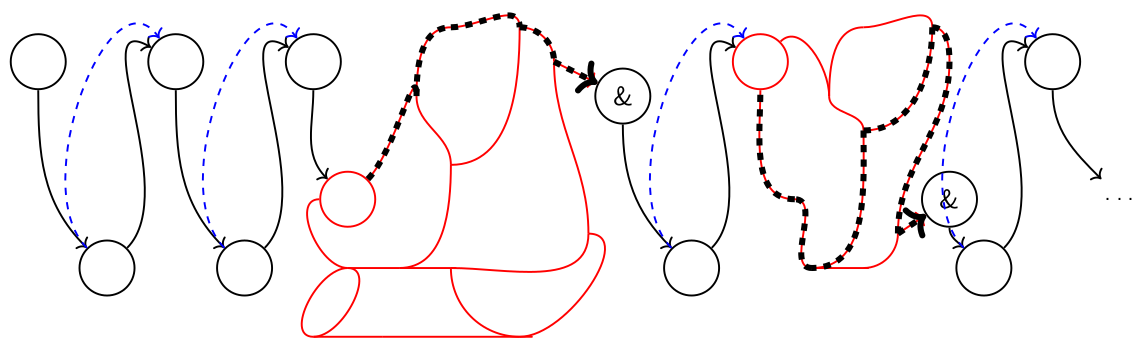
With Thomas Ehrhard and Claudia Faggian at FSCD 2026, Proof Society 2026 and LIQCS 2026
Conference version at FSCD 2026:
Abstract
Quantum Bayesian networks provide a mathematical formalism to describe causal relations, to analyse correlations, and to predict the probabilities of measurement outcomes, in systems involving both classical and quantum data. They generalize Pearl’s Bayesian networks—prominent graphical models for classical probabilistic reasoning and inference.
The goal of this paper is to bring compositional principles and a typing discipline into this setting. A key feature of our compositional semantics is that when all causes are classical, it coincides with the standard factor-based semantics of Bayesian networks, while in the purely quantum case it reduces to tensor networks. We then propose a typed formalism based on linear logic proof-nets, where types ensure well-behaved composition of systems, and which we prove sound and complete with respect to quantum Bayesian networks.
Abstract
Quantum Bayesian networks provide a mathematical formalism to describe causal relations, to analyse correlations, and to predict the probabilities of measurement outcomes, in systems involving both classical and quantum data. They generalize Pearl’s Bayesian networks—prominent graphical models for classical probabilistic reasoning and inference.
This extended abstract reports on work which brings compositional principles and a typing discipline into this setting. A key feature of our compositional semantics is that when all causes are classical, it coincides with the standard factor-based semantics of Bayesian networks, while in the purely quantum case it reduces to tensor networks. We then propose a typed formalism based on proof-nets from linear logic, where types ensure well-behaved composition of systems, and which we prove sound and complete with respect to quantum Bayesian networks.
Abstract
Quantum Bayesian networks provide a mathematical formalism to describe causal relations, to analyse correlations, and to predict the probabilities of measurement outcomes, in systems involving
both classical and quantum data. They generalize Pearl’s Bayesian networks—prominent graphical models for classical probabilistic reasoning and inference.
This extended abstract reports on work which brings compositional principles and a typing discipline into this setting. A key feature of our compositional semantics is that when all causes are classical, it coincides with the standard factor-based semantics of Bayesian networks, while in the purely quantum case it reduces to tensor networks. We then propose a typed formalism based on linear logic proof-nets, where types ensure well-behaved composition of systems.

At TLLA 2026
Related to an extended draft and a note
Abstract
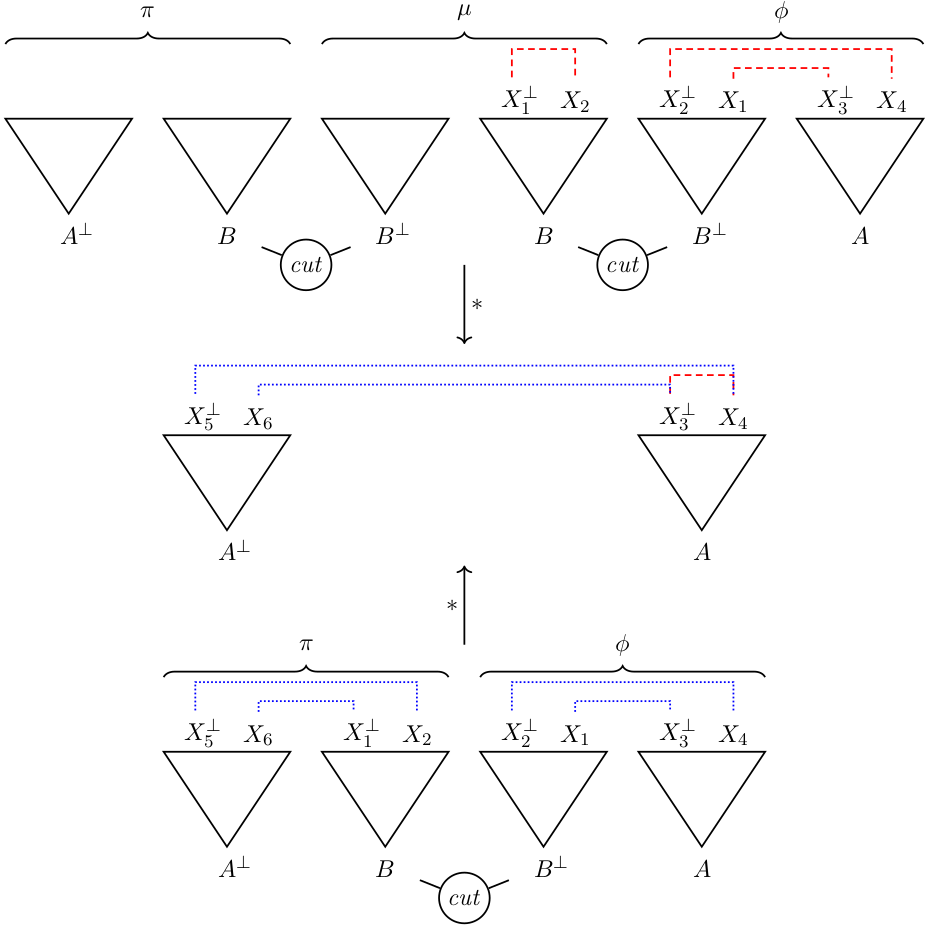
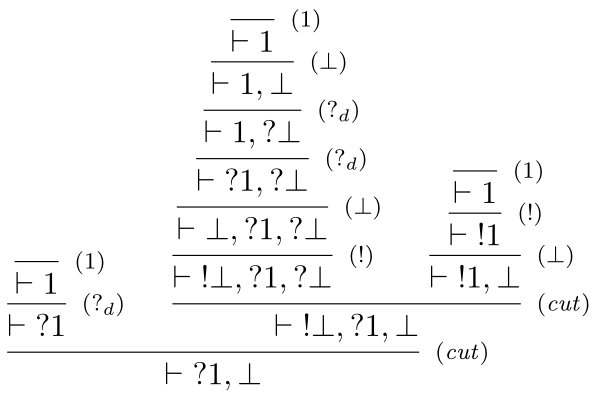
Proofs in a logic are usually considered (at least) up to cut-elimination. This is the case in linear logic, that also has another equivalence relation on proofs: rule commutation. We prove these two notions coincide in second-order linear logic and many of its fragments. Moreover, we show that equality up to rule commutation is undecidable in propositional linear logic—and so is equality up to cut-elimination.

With Olivier Laurent at LMCS and FSCD 2023
Journal version at LMCS: (after invitation, extended version of the conference version)
Abstract
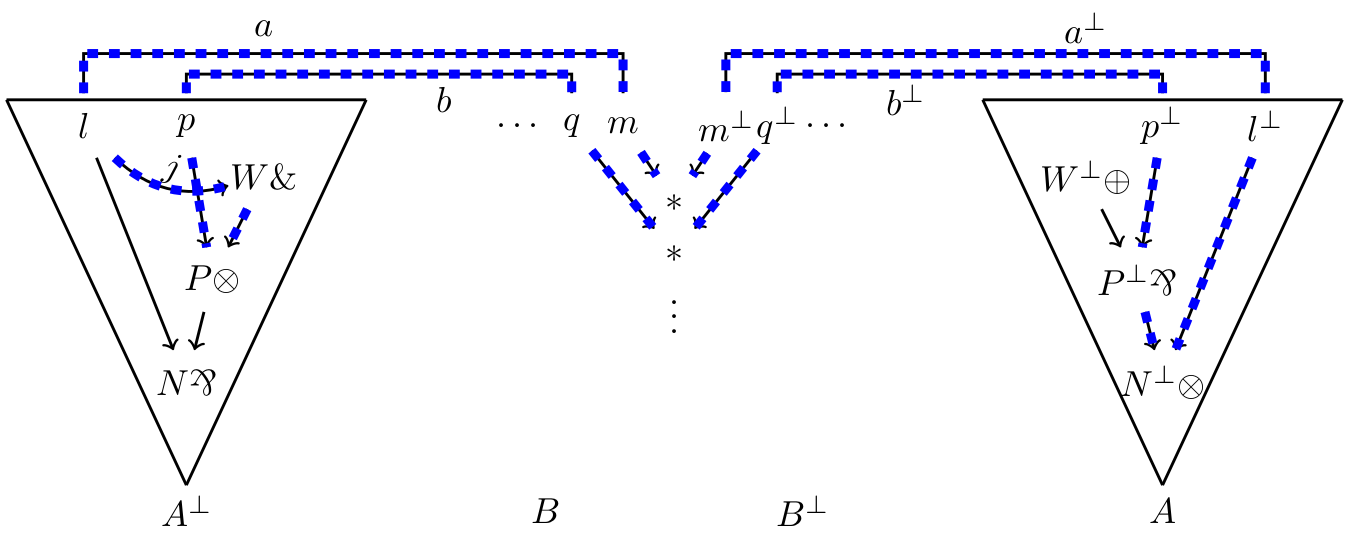
We characterize type isomorphisms in the multiplicative-additive fragment of linear logic (MALL), and thus in *-autonomous categories with finite products, extending a result for the multiplicative fragment by Balat and Di Cosmo. This yields a much richer equational theory involving distributivity and cancellation laws. The unit-free case is obtained by relying on the proof-net syntax introduced by Hughes and Van Glabbeek. We use the sequent calculus to extend our results to full MALL, including all units, thanks to a study of cut-elimination and rule commutations.
Abstract
We characterize type isomorphisms in the multiplicative-additive fragment of linear logic (MALL), and thus for *-autonomous categories with finite products, extending a result for the multiplicative fragment by Balat and Di Cosmo. This yields a much richer equational theory involving distributivity and annihilation laws. The unit-free case is given by relying on the proof-net syntax introduced by Hughes and Van Glabbeek. We then use the sequent calculus to extend our results to full MALL (including all units).
With Olivier Laurent at TLLA 2025
See Software Development for the code
Abstract
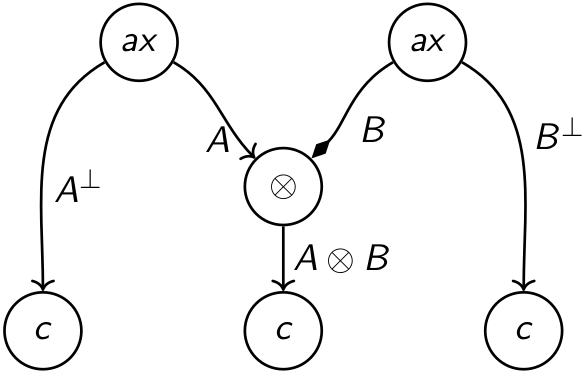
We present an implementation of proof-nets for unit-free multiplicative linear logic in the proof assistant Rocq. It contains a definition of proof-structures and proof-nets, a proof of the sequentialization theorem as well as a definition of cut-elimination.
With Olivier Laurent, Lorenzo Tortora de Falco and Lionel Vaux Auclair at FSCD 2025
To be superseded by its journal version
Abstract
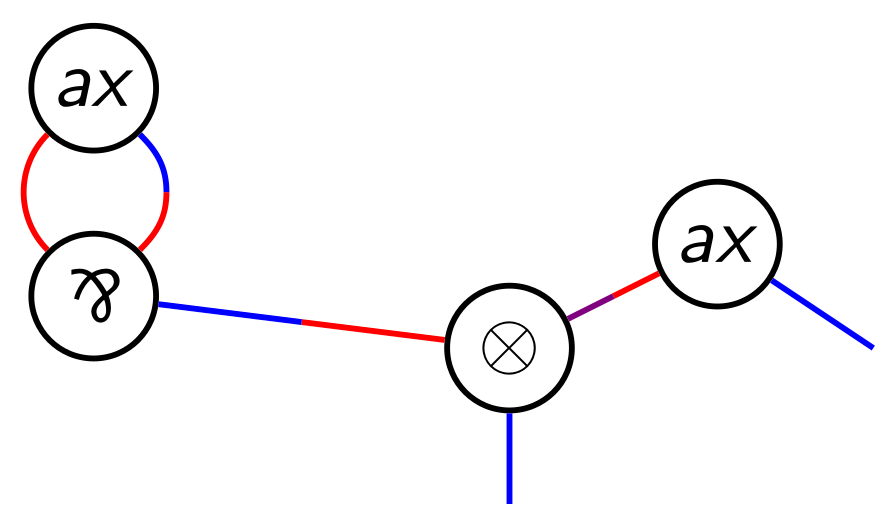
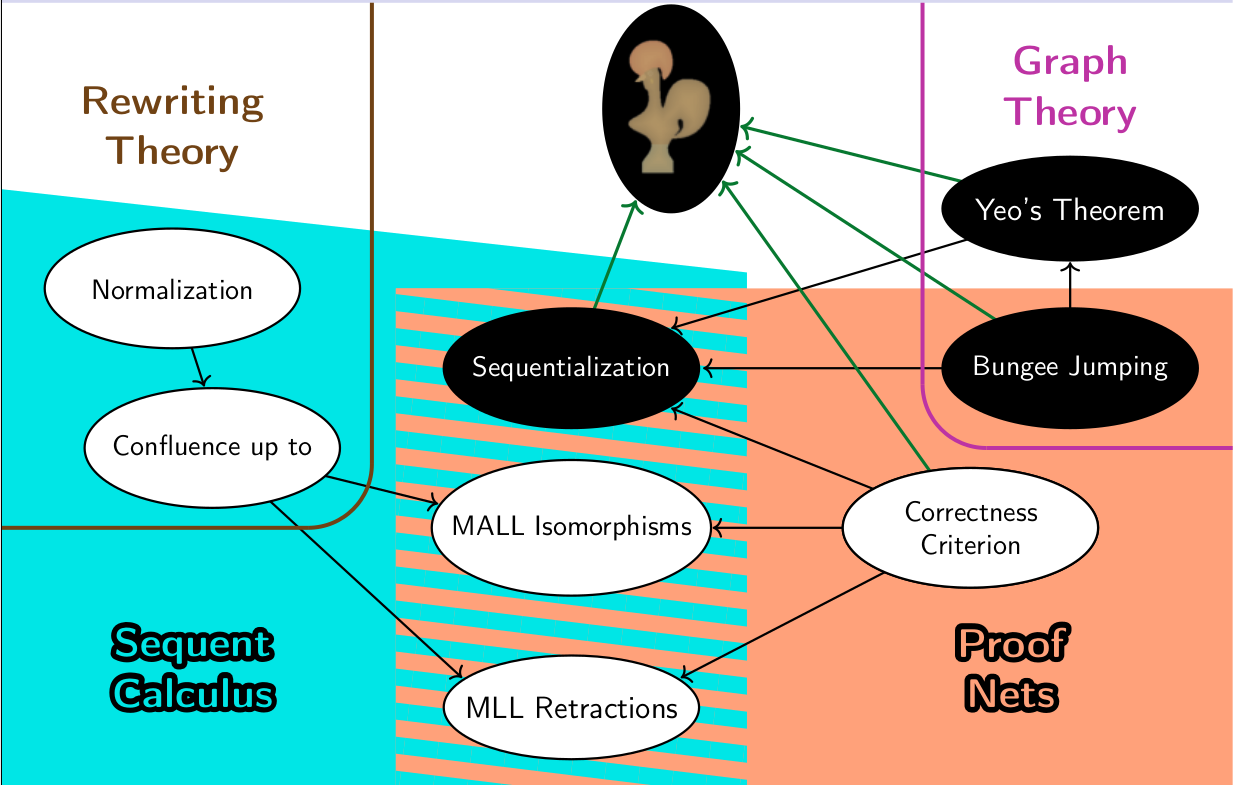
We revisit sequentialization proofs associated with the Danos-Regnier correctness criterion in the theory of proof nets of linear logic. Our approach relies on a generalization of Yeo's theorem for graphs, based on colorings of half-edges. This happens to be the appropriate level of abstraction to extract sequentiality information from a proof net without modifying its graph structure. We thus obtain different ways of recovering a sequent calculus derivation from a proof net inductively, by relying on a splitting par-vertex, on a splitting tensor-vertex, on a splitting terminal vertex, etc.
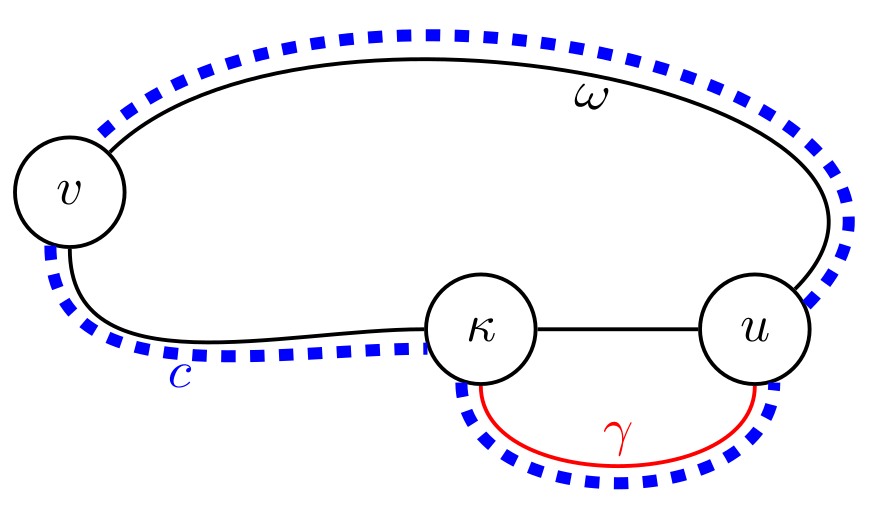
The proof of our Yeo-style theorem relies on a key lemma that we call cusp minimization. Given a coloring of half-edges, a cusp in a path is a vertex whose adjacent half-edges in the path have the same color. And, given a cycle with at least one cusp and subject to suitable hypotheses, cusp minimization constructs a cycle with strictly less cusps. In the absence of cusp-free cycles, cusp minimization is then enough to ensure the existence of a splitting vertex, i.e. a vertex that is a cusp of any cycle it belongs to. Our theorem subsumes several graph-theoretical results, including some known to be equivalent to Yeo's theorem. The novelty is that they can be derived in a straightforward way, just by defining a dedicated coloring, again without any modification of the underlying graph structure (vertices and edges) - similar results from the literature required more involved encodings.
Supervised by Olivier Laurent at Ecole Normale Supérieure de Lyon
Defended on Sepember 23, 2024 in Salle des Thèses and online on BBB (unrecorded)
The Manuscript has less typographical mistakes than the HAL and Theses.fr versions
With Olivier Laurent, Lorenzo Tortora de Falco and Lionel Vaux Auclair at TLLA 2023
Abstract
We propose a new proof of sequentialization for the proof nets of unit-free multiplicative linear logic with mix. It is based on the search of a splitting par by means of a simple new lemma about proof structures: the bungee jumping lemma.
With Olivier Laurent at Linearity - TLLA 2022
Abstract
We propose a new proof of sequentialization for the proof nets of unit-free multiplicative-additive linear logic of Hughes & Van Glabbeek. This is done by adapting a method from unit-free multiplicative linear logic, showing the robustness of this approach.